
THE AMBER ECONOMY
Introduces a new economic perspective for understanding how food systems generate value
Traditional economic models evaluate food primarily through production levels, market prices and trade flows. While these metrics are important, they capture only a limited portion of the value embedded in food.
The Amber Economy expands this perspective by examining how food contributes simultaneously to economic activity, human nutrition, social stability, territorial resilience and environmental sustainability.
This approach allows food systems to be evaluated not only by how much they produce, but by how effectively they preserve and distribute the value contained in food.
Rethinking Food as a Strategic Asset

In most economic models, food is treated primarily as a commodity.
Within this perspective, its value is defined mainly by market price and commercial exchange. However, food carries far more significance for societies than what market valuation alone can capture.
The Amber Economy proposes a different understanding: food should be recognized as a strategic asset for human development, social stability and territorial resilience.
Every unit of food embodies natural resources, human labor, knowledge, infrastructure and cultural heritage. Recognizing this broader role is essential for designing food systems that serve both economies and societies.
Food is not only a commodity. It is a strategic asset that sustains economies, societies and ecosystems.
From Commodity Optimization to Value Preservation
Current food systems have been designed primarily to maximize production and improve efficiency.
While these objectives have increased global food availability, they have not ensured that the full value embedded in food is preserved across the system.
The Amber Economy proposes a fundamental shift — from a logic of commodity optimization to a logic of value preservation.
Instead of asking only how to produce more food, the central question becomes:
How can food systems preserve the full value contained in food as it moves from production to consumption?
This perspective changes how food systems are analyzed, governed and managed.
Understanding Value Destruction
The Amber Economy explains how value is systematically destroyed within food systems. Food loss and waste are the most visible expressions of this phenomenon, but value also disappears through several structural failures.

Food loss and waste

Inefficient logistics

Nutritional degradation

Fragmented governance

Disconnection between production and consumption
When these failures occur, multiple forms of value disappear at the same time: Economic value, Nutritional value, Environmental value, Territorial value
Understanding these mechanisms is essential to redesign food systems that preserve value instead of destroying it.
A Framework for Policy, Business and Institutions
The Amber Economy can guide decision-making across governments, businesses and international institutions.

For governments, it provides a basis for designing food policies that prioritize long-term resilience, food security and sustainable development.

For businesses, it introduces new ways to improve efficiency, traceability and value optimization across supply chains.

For international organizations and development institutions, it creates a common analytical framework that can support coordinated action across regions and sectors.
By redefining how food value is understood, the Amber Economy helps align economic incentives with broader societal outcomes.
A Systemic Perspective
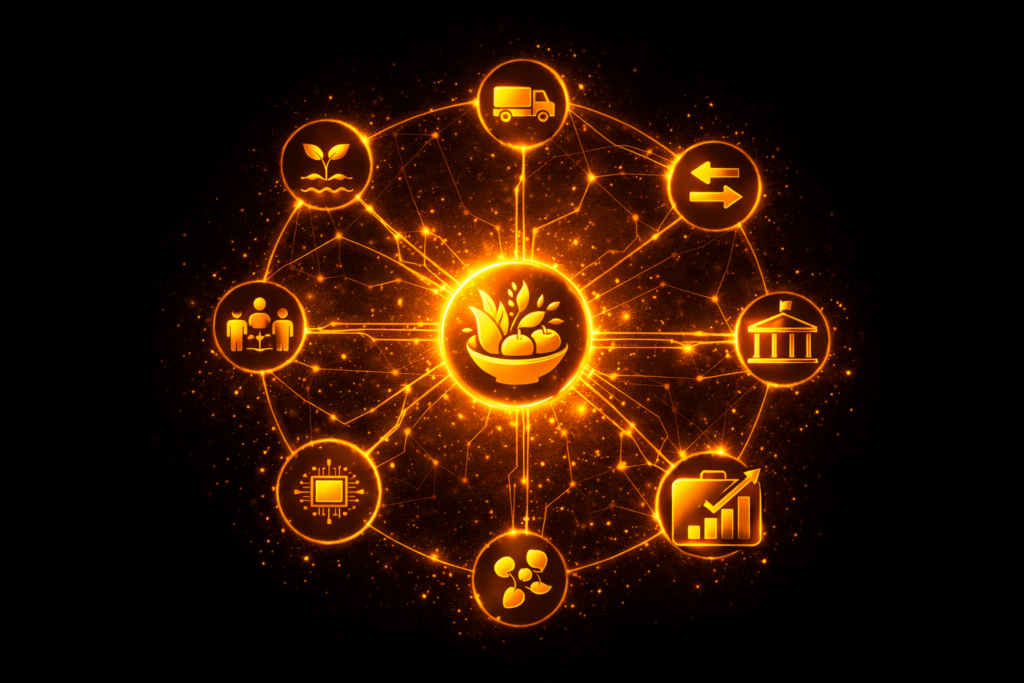
Food systems are complex networks involving agriculture, logistics, trade, public policy, technology, finance and social institutions.
Changes in one part of the system inevitably affect the others.
For this reason, the Amber Economy adopts a systemic perspective that analyzes how value flows across the entire food system.
From Concept to Transformation
The Amber Economy is not intended to remain only a theoretical proposal.
Its purpose is to support real transformation in the way food systems are understood, governed and managed.
Through international collaboration, policy innovation, technological platforms and multi-stakeholder initiatives, the principles of the Amber Economy can be translated into practical solutions.
By placing the preservation of food value at the center of decision-making, societies can move toward food systems that generate not only food, but also resilience, wellbeing and sustainable prosperity.

Join the Transition
Governments, businesses, researchers, international organizations and innovators all play a role in transforming food systems.
The Amber Economy provides a shared framework for collaboration and action.
Together, we can redesign food systems so that food generates not only economic activity, but also resilience, wellbeing and sustainable prosperity.
© 2025, Karen Lorena Brugés Solórzano & Mónica Colín de Velázquez