
ABOUT US
The Vision Behind the Amber Economy
Food Impact Economy is a framework co-developed by economist Mónica Colín and ecosystem builder Karen Brugés.
Food systems shape economies, societies and the wellbeing of entire populations. Yet today they operate under economic logics that prioritize production and trade, while enormous amounts of value embedded in food are lost before reaching their highest human purpose.
The Amber Economy proposes a different perspective. It recognizes food not merely as a commodity, but as a strategic asset capable of generating economic, nutritional, environmental, territorial and social value. From this lens, food loss and waste are not simply inefficiencies — they represent the systematic destruction of value within food systems.
This framework opens the path toward a new way of understanding and governing food systems. The Global Coalition for the Preservation of Food Value was created to translate this vision into coordinated international action capable of preserving food value and transforming food systems.
The Authors

Dr. Karen Lorena Brugés Solórzano
Karen Lorena Brugés Solórzano is a social worker, international speaker and ecosystem builder working at the intersection of food systems transformation, economic innovation and global collaboration.
Her work focuses on designing frameworks that help societies rethink how value is created and preserved across complex systems. Through her initiatives, she has built international alliances connecting institutions, technology and social innovation to address challenges such as food insecurity, food waste and sustainable development.
With nearly two decades of experience across the private sector, social innovation and international collaboration, she brings together diverse actors to transform ideas into collaborative platforms capable of generating measurable impact
Her work explores how food systems can be reimagined, positioning food as a strategic asset capable of generating economic, nutritional, environmental, territorial and social value.

PhD. Mónica Colin de Velásquez
Mónica Colin de Velásquez is an economist and strategic thinker specializing in economic systems, development models and institutional design, with a focus on the structural dynamics that shape how value is created and distributed across societies.
Her work examines how economic incentives, governance structures and institutional coordination influence the functioning of complex systems such as food systems, territorial development and sustainable economic growth.
Through her research and analytical work, she contributes conceptual frameworks that help interpret systemic challenges and explore how economic models can evolve to address issues such as food security, resource efficiency and sustainable development.
Her work contributes to the economic and analytical foundation behind the Food Impact Economy and the Amber Economy, helping redefine how food systems are evaluated through the lens of integrated economic, nutritional, environmental, territorial and social value.
The Book: Food Impact Economy – Toward an Amber Economy
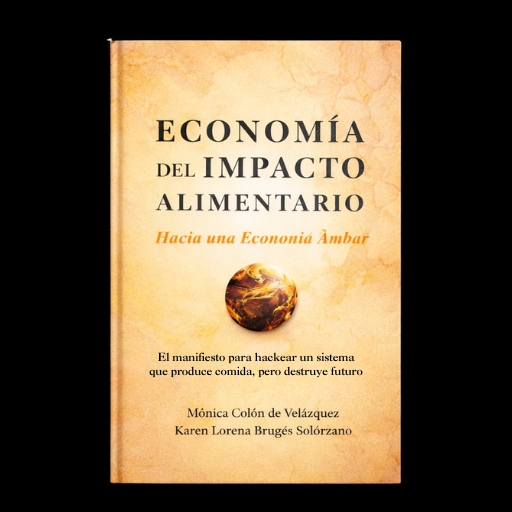
The book will be officially launched at the International Book Fair of Bogotá (FILBo) 2026, one of the most important literary and intellectual events in Latin America.
The publication explores a fundamental paradox of modern food systems.
Humanity produces enough food to feed everyone.
Yet millions of people remain food insecure while enormous volumes of food are lost or wasted every year.
The problem is not simply waste.
We are not wasting food. We are destroying value.
By reframing food loss and waste as the destruction of economic, nutritional, environmental and social value, the book introduces a new economic narrative capable of guiding policy, innovation and international collaboration.
This perspective leads to the concept of the Amber Economy, a framework designed to place the preservation of food value at the center of economic and institutional decision-making.
© 2025, Karen Lorena Brugés Solórzano & Mónica Colín de Velázquez