
FOOD IMPACT ECONOMY
Rethinking how the world values food
A framework for transforming global food systems and accelerating the transition toward an Amber Economy
Humanity produces enough food to nourish everyone on the planet.
Yet millions of people remain food insecure while enormous volumes of food are lost or wasted every year.
This contradiction reveals a deeper issue. Our food systems still treat food as a commodity, when in reality it is one of the most strategic assets for human wellbeing, economic stability and territorial resilience.
Food Impact Economy proposes a new way to understand and transform food systems.
The Global Food Paradox
Food systems today face a structural paradox.
Global agriculture produces vast quantities of food, yet hunger, malnutrition and unequal access persist in many regions of the world. At the same time, large volumes of edible food never reach people because they are lost, discarded or poorly coordinated within supply chains.
This is not only a logistical problem. It is a problem of economic design.
When food is treated purely as a market commodity, the broader value embedded in it remains invisible.

Food Impact Economy is a framework co-developed by economist Mónica Colín and ecosystem builder Karen Brugés
Food Impact Economy
Food Impact Economy is a framework for transforming how food systems are understood, governed and evaluated.
Instead of measuring success only through production or trade, this approach evaluates food systems according to the impact they generate for people, communities and the planet.
The goal is to move from food systems focused only on volume and efficiency toward systems capable of preserving and maximizing the full value embedded in food.
Amber Economy
The Amber Economy provides the economic logic behind this transformation.
It recognizes food not simply as a product, but as a strategic asset that generates multiple forms of value. Every unit of food carries economic value, nutritional value, social value, territorial value and environmental value.
When food is lost or wasted, these forms of value disappear simultaneously.
Amber Economy therefore reframes food systems through a central question:
How much food value is created, preserved, destroyed or redirected within the system?
The Five Dimensions of Food Value
Food is far more than a commodity. Each unit of food carries multiple layers of value that are essential for societies and territories.
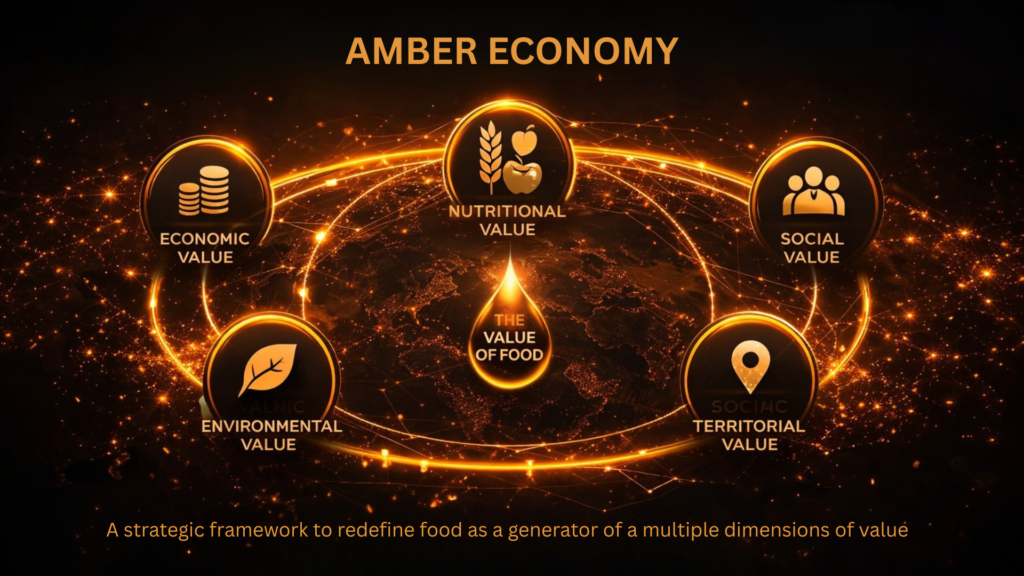
Economic value Food production sustains livelihoods and markets
Nutritional value Food supports health and human development.
Social value Food systems influence inclusion and access.
Territorial value Food systems shape regional resilience.
Environmental value – Food production interacts directly with ecosystems and natural resources
Understanding these dimensions is key to transforming food systems.
From Concept to Global Action
Food Impact Economy
The conceptual framework that redefines how societies measure and understand the value of food.
Amber Economy
The economic paradigm that emerges when food value is preserved across production, distribution and consumption systems.
Global Coalition
The international platform that mobilizes institutions, technology and leadership to implement this transition.
The Ecosystem
Food Impact Economy is not only a conceptual proposal. It is an ecosystem designed to transform food systems through coordinated action across institutions, sectors and territories.
This ecosystem brings together economic frameworks, governance platforms, technological infrastructure and global leadership networks working toward a common goal: preserving the full value of food.

Key Components of the Ecosystem
The ecosystem integrates five complementary components.
Food Impact Economy defines the broader vision for transforming food systems around measurable impact for people, communities and the planet.
Amber Economy provides the economic framework that explains how food value is created, preserved, destroyed or redirected within food systems.
Amber Economy Lab- serves as the international platform for multi-stakeholder coordination and collective action.
Together these components connect vision, governance, leadership and technology to enable systemic transformation.
Why This Matters
Food systems influence some of the most critical challenges of our time.
Food loss and waste, food insecurity, hidden environmental costs, territorial vulnerability and institutional fragmentation are often treated as separate problems. In reality they are deeply interconnected.
Amber Economy offers a unifying perspective by focusing on the preservation of food value.
By redesigning how food systems recognize and manage value, it becomes possible to generate better outcomes for nutrition, sustainability, resilience and economic development.
Join the Transition
Transforming food systems requires collaboration across sectors, disciplines and territories.
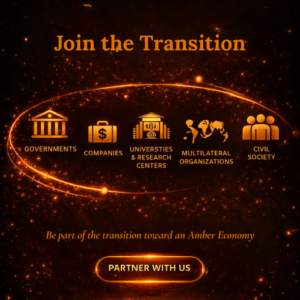
Food Impact Economy invites governments, companies, multilateral organizations, universities and civil society actors to participate in the transition toward an Amber Economy.
Together it is possible to redesign food systems so that they generate not only food, but also resilience, wellbeing and shared prosperity.
© 2025, Karen Lorena Brugés Solórzano & Mónica Colín de Velázquez